Group to withdraw from Cornwall after years of retrenchment. Andrew Garnett reports
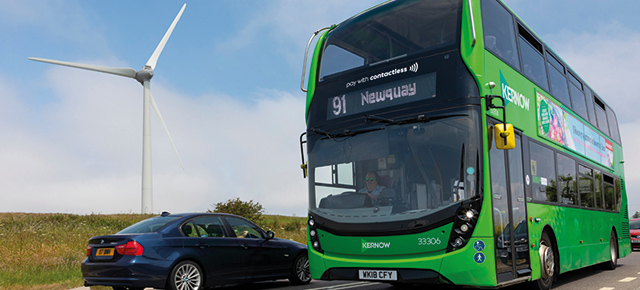 Be my Valentine? First Kernow will close on February 14
First Bus has announced plans to cease all operations in Cornwall by mid-February 2026, bringing to an end more than a decade of significant investment, restructuring and ultimately contraction in a market the operator once regarded as a flagship example of partnership working.
The decision to close First Kernow follows sustained financial pressures, ailing patronage and the emergence of strong competition from Go-Ahead subsidiary Go Cornwall Bus, which has expanded rapidly since taking on Cornwall Council’s supported bus network in 2020.
In its announcement, First highlighted above-inflation costs, a 21% year-on-year fall in passenger numbers on top of a 13% decline in 2024/25, and a heavily loss-making operation as the core reasons behind its decision to quit Cornwall. The operator currently runs 14 routes with a fleet of 85 vehicles across depots in Camborne, Falmouth, Penzance, Summercourt and Truro. Around 275 jobs are at risk, although First says it will work to identify redeployment opportunities elsewhere.
“This was an extremely difficult decision, which was made after all other options were exhausted,” said Simon Goff, First Bus South’s managing director.
“We understand this news will be deeply disappointing for our colleagues and passengers.
“Our proposal to exit the market in Cornwall isn’t a process that we have entered into lightly.”
A new beginning?
Almost a decade ago, First Kernow was positioned as a turnaround success. Following a period of contraction and depot closures since the 1990s, First embarked on a substantial investment programme aimed at stabilising performance and demonstrating the effectiveness of partnership working. New buses – the first for many years for a business which had come to rely of elderly cast-offs from elsewhere within the group – were introduced, routes were upgraded and Cornwall became something of a showcase for First with a high-frequency interurban network connecting Cornwall’s major conurbations and branded as First Kernow.
Our proposal to exit the market in Cornwall isn’t a process that we have entered into lightly
This approach chimed with Cornwall Council’s own policy direction at the time, which favoured enhanced partnerships rather than regulatory intervention. The council’s long-term transport strategy spoke of integrated ticketing, consistent branding and joint marketing. The operator-authority relationship was viewed positively within the industry, and the partnership model was frequently cited as an example of how voluntary arrangements within a deregulated framework could deliver passenger growth outside metropolitan areas.
However, the landscape has changed markedly in recent years, in particular since the Covid-19 pandemic. The introduction of the government-backed Transport for Cornwall partnership in 2020, alongside £23.5m through the Bus Service Improvement Plan, effectively reshaped the structure of the local market. Go-Ahead-owned Go South West was the surprise victor of a council contract to operate an extensive network
of supported services. It saw
Go South West’s embryonic Go Cornwall Bus operation, formed from the ashes of Western Greyhound’s Liskeard business, significantly expand, giving the Go-Ahead subsidiary a larger presence in Cornwall. While First retained a significant commercial network, the balance of influence had clearly shifted.
Rapid retrenchment
The pressures on First have intensified steadily since then, leading to some decisions that industry observers have branded as distinctly odd. Following the departure of highly respected First South West managing director Alex Carter in 2021, who was credited with reviving the fortunes of the business, First’s bus interests in the south west of England were bolted onto the Hampshire, Dorset and Berkshire operation, led by Goff.
Then in early 2025 the operator announced it would no longer run its seasonal open-top services, including the Atlantic Coaster between Newquay and Padstow and the Lands End Coaster linking Penzance, Lands End and St Ives. These routes had been part of First’s distinct regional identity and were often promoted jointly with the tourism bodies.
Further contractions followed in early 2025 when First handed back several school transport contracts to Cornwall Council, stating it would cease running them at the end of the summer term. Although First bid for the replacement contracts, it was unsuccessful. The loss of the Truro and Penwith College student routes later in the year – also to Go Cornwall Bus – added to the mounting challenges and reduced First’s presence further in a market it had once dominated.
Meanwhile, competition intensified in August when Go Cornwall Bus introduced additional commercial routes paralleling key First services. These included the GCB41 against First’s T1/T2 between Camborne and Truro, the GCB32 competing with the U1 between Falmouth and Truro, the GCB2/2A replicating the U4 between Helston and Penzance and the GCB86 overlapping First’s 87 between Newquay and Truro. The move prompted industry commentator Roger French to observe that Go-Ahead had “decided to go for the kill and aggressively compete with what can only be described as an ailing First Kernow”.
While neither operator has publicly acknowledged these changes as an aggressive strategy, their combined effect has been to erode First’s commercial foothold. Alongside shifts in travel patterns, including reduced commuting and, surprisingly, what it claims has been a weaker tourism market, First has struggled to return the business to profitability. In its statement, First said it had explored network changes, depot rationalisation and partnership initiatives, but the Cornwall business still remained financially unsustainable.
Go South West pounces
In echoes of the group’s decision following First’s withdrawal from the Southampton bus market in early 2023, Go-Ahead has confirmed it will expand to fill the void in Cornwall. Go South West said this week it is working with Cornwall Council to design a revised but comprehensive network to ensure continuity of services across the county. The operator highlighted its commitment to maintaining accessibility to employment, education, healthcare and leisure, noting the long-standing role it has carved out within the region.
Cornwall is our home, and we are committed to protecting the bus services that so many people rely on
“Cornwall is our home, and we are committed to protecting the bus services that so many people rely on,” said Go South West managing director Richard Stevens. “We will be introducing a revised but comprehensive network that keeps every community connected. Our priority is to ensure that any area currently served by First South West continues to have access to bus services.”
Martin Dean, Go-Ahead’s managing director of its regional bus division in the UK, added Go South West’s parent company was dedicated to keeping communities connected. “We fully support the team at Go South West as they prepare for this important transition in Cornwall and are proud of the leadership and care they show for their communities,” he added.
Replicating Southampton
For now First will continue to operate its existing routes until the end of service on February 14. Further details about the planned transition are expected before Christmas.
Although the exit marks the end of First’s long-standing presence in Cornwall, the circumstances reflect broader pressures across the bus sector; cost inflation, structural shifts in demand, and, in many cases, falling patronage.
Go-Ahead succeeded in reviving Southampton’s bus market following First Bus’s withdrawal – can they now repeat the trick in Cornwall?
This article appears in the latest issue of Passenger Transport.
DON’T MISS OUT – GET YOUR COPY! – click here to subscribe!