Supporting the bus sector’s ambitions for growth remains one of this government’s top priorities
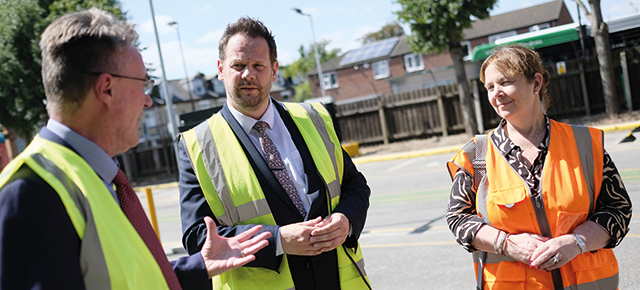 Simon Lightwood during a visit to NCT last year
BY Simon Lightwood
While for many of us, new pencil cases and fresh exercise books are a distant memory, September still stirs a familiar feeling. With excitement and anticipation in the air, this is the perfect time to reflect on our achievements and reset our focus for the coming year. Ahead of this month’s UK Bus Summit, I’d like to share my thoughts on our journey so far.
Thanks to the efforts of operators and local transport authorities, patronage across the country is now making its way back to pre-pandemic levels. This is a stellar result and puts the industry in a strong position to continue growing. Supporting the sector to do this remains one of government’s top priorities and I’ve been delighted to see our reform agenda kicking into gear.
We recognise buses’ potential to connect people, places and possibility. Not only do high-quality services support buoyant local economies, they also deliver opportunities and help our communities to thrive. Whether it’s journeys to work, to school or the supermarket, it’s difficult to overstate just how important buses are to Britain’s every day.
That’s why the Bus Services Bill was one of the first major pieces of legislation this government introduced. Enduring the House of Commons’ committee rooms during a heat wave was more than worth it to see the Bill through to the next stage, taking us one step closer to completion.
We know that politicians in Westminster are not best placed to run services in Wakefield, Wolverhampton or Woking. Instead, the Bill empowers local leaders to choose the operating model that works best for their area, whether that’s franchising, Enhanced Partnerships or Local Authority Bus Companies.
Franchising has made a real difference in cities like Manchester. We want to extend this opportunity to more areas, although we know that a one size fits all approach won’t be suitable. Over the coming months, we’ll be running pilots to test different franchising models with rural and other authorities, helping us to understand how this approach can best work for these communities. It’s also great to see that Enhanced Partnerships have improved services in places like Hertfordshire and Norfolk. An upcoming review, as well as changes made in the Bill, will help ensure this success can be replicated in other places.
We’ve made great progress since last July, and I’m incredibly grateful for the energy and enthusiasm this sector has shown
Since the election, we’ve consistently put our money where our mouth is. Last Autumn, we confirmed £1bn to support and improve bus services and keep fares affordable. This did not come with a list of caveats and limitations, bound together by reams of red tape. Instead, we’re giving local leaders the flexibility to invest in what matters most to their community. At the Spending Review, we confirmed further funding to maintain and improve bus services every year. This includes extending the £3 fare cap until March 2027 to put more money in passengers’ pockets.
Despite the challenging economic climate we inherited, this government has prioritised bus services time and time again. I hope our investment has shown Passenger Transport readers just how serious we are about working with the sector to drive improvements up and down the country.
I know many readers have also been flying the flag for cleaner, greener buses. With lower running costs, cleaner air and smoother journeys, the transition to zero-emission buses (ZEBs) is a central part of government’s long-term plan. It’s good news that 50% of new buses registered last year were zero emission, but we need to go further, and we need to go faster. That’s why government announced a further investment of £38m in April to deliver over 300 new ZEBs and why we launched the UK Bus Manufacturing Expert Panel back in March. By bringing together industry experts and local government, we can secure the UK’s position as a global leader in bus manufacturing for years to come.
As we turn our thoughts to what’s ahead, government will continue working hand in hand with this industry to deliver on our Plan for Change. As I recently told the Transport Select Committee, one of my key priorities is to rebuild trust. I want people to trust their bus to arrive on time, trust it will take them where they need to go, and trust that the service has been designed with their community in mind.
We’ve made great progress since last July, and I’m incredibly grateful for the energy and enthusiasm this sector has shown. Now it’s time to sharpen our pencils, roll up our sleeves and get ready to tackle the year ahead.
ABOUT THE AUTHOR: Simon Lightwood MP, minister for local transport, will give the keynote address – Better Buses Ahead: The Plan for Change – the UK Bus Summit in Manchester on September 11
This story appears inside the latest issue of Passenger Transport.
DON’T MISS OUT – GET YOUR COPY! – click here to subscribe!