Local authorities have an opportunity to make journeys simpler, information clearer, and fares fairer
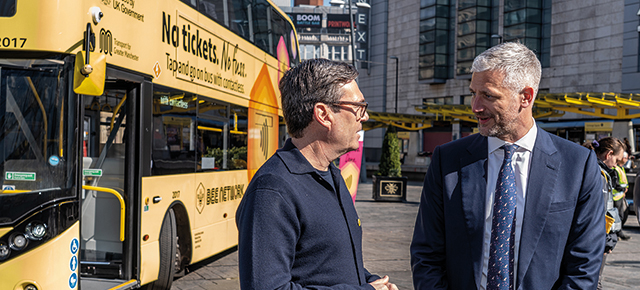 Andy Burnham, mayor of Greater Manchester, with Aaron Ross, CEO of Vix Technology and Kuba Group at TfGM’s Tap & Go Launch
Local transport authorities are at a crossroads. They can finally turn their back on the deregulation of bus services, thanks to legislation granting them franchising powers. While legal frameworks differ across the UK, the ambition is the same: to give local authorities greater freedom to create passenger-focused networks.
Buses, traditionally the backbone of
British public transport, have drifted away from meeting communities’ needs.
For decades, profit-driven management has resulted in fragmented services, complex fares and unreliable performance.
Now, bus franchising presents an opportunity for local authorities to take back control and redesign bus networks. They can return bus services to their roots of connecting people and places, and creating opportunities.
In Greater Manchester, Transport for Greater Manchester (TfGM) is leading by example. For mayor Andy Burnham, bus franchising is more than a shift in policy. It’s a chance to reimagine regional mobility, delivering seamless journeys that link buses, trams, and eventually, rail.
Manchester’s vision for the Bee Network extends beyond buses – it’s focused on opening-up the city-region’s mobility network, making it reliable, integrated and affordable to use.
Why integrated mobility matters
With franchising, local authorities move from being spectators to architects. No longer constrained, they can lead mobility innovation, creating joined-up, responsive, accessible public transport that truly works for people.
They have an opportunity to remove some of the most persistent barriers to using public transport. These include complex ticketing systems that require passengers to buy multiple tickets to complete a journey; confusing fares; and a lack of accessible, reliable real-time travel information.
As barriers fall, opportunities grow. When people enjoy using public transport, they use it more, and are better connected to jobs, education, friends, and family. There’s a
far-reaching ripple effect: communities and local economies are stronger; and real progress is made on climate commitments.
Tech that powers transformation
Local authorities need technology systems that deliver their vision for bus franchising. It’s essential to interrogate their objectives at the start and choose platforms and partnerships that give them a clear path to success.
While the systems may be complex, procurement and deployment can be made easy by working with knowledgeable and supportive specialists.
The infrastructure on a local authority’s shopping list will include:
1. Confidence in every journey
When information is open and accessible, managing transport networks, and keeping passengers in the loop, is much easier. Real-time passenger information builds trust and ensures everyone, from seasoned commuters to first-time riders, can move confidently. Updates are available wherever people need them – on the street, on the bus, or in an app – making every journey easier and less stressful.
2. Simplifying fare payments
You’ll find a frictionless payment system at the heart of every successful regional mobility network. Greater Manchester’s Bee Network, as an example, uses Vix Technology’s account-based ticketing system to simplify fare payments.
As barriers fall, opportunities grow. When people enjoy using public transport, they use it more
This platform brings buses and trams together into a contactless Tap and Go system, with heavy rail due to follow. Riders tap-on with a bank card or mobile wallet, and always get the best fare, with daily and weekly fare caps taken into account. For passengers, it’s hassle-free, providing value on the go.
3. Flexibility without limits
Choosing modular technology components that integrate using standard APIs can enrich operations with valuable data, and build flexibility into systems. Authorities procuring these types plug-and-play systems are ready for the future. When the time comes for upgrades, they won’t be hamstrung by vendor lock-in – they will have their pick of solutions from a competitive marketplace.
4. Connected and protected systems
As systems become more interconnected, they need armour that protects them from cyber attack. Authorities must invest in secure platforms that meet robust industry standards. At Vix, we support our partners with Security-as-a-Service, handling certifications and compliance, and safeguarding data and privacy. Security underpins every link in the chain of our systems, giving our customers peace of mind, and enabling them to focus on delivering better services.
Rightsizing bus franchising
Franchising is intentionally flexible, rather than a black and white opportunity. Local authorities can assume different levels of control and accountability, depending on their needs, budgets, and capabilities.
The most robust model of bus franchising – pursued by TfGM and Transport for London – sees the authority take end-to-end responsibility for ticketing, information systems, and even network branding.
The authority owns and operates all technology systems, from on-bus validators to real-time information, mobile apps, and payment processing. Operators are contracted purely for driver and vehicle management.
Whichever version of bus franchising they pursue, guidance from the Department for Transport urges authorities to consider upcoming targets for seamless ticketing and service unification with commuter rail by 2028.
So, while there is freedom in the delivery of franchising, multi-modal integration is key. Investing in interoperable technology will open-up potential to reuse what works, welcome innovation, and create a positive, holistic mobility experience.
Great power – and great responsibility
Bus franchising, supported by flexible technology, has the potential to unlock a brighter future for bus travel and broader mobility networks in the UK. After decades of decline, local authorities have an opportunity to restore confidence in public transport, by making journeys simpler, information clearer, and fares fairer.
Upfront investment can be offset quickly. Smart procurement and repurposing of existing front office infrastructure can help improve sustainability and accelerate return through lower operational costs. With total control over standards, and the tools to track and measure performance, they can continually improve services.
Responding to local needs with greater agility than ever before, they can strengthen communities for the long-term.
Lessons from Manchester: Open, modular, ready for growth
The Bee Network is living proof of the power of open technology. Transport for Greater Manchester (TfGM) set the bar for bus franchising high, leapfrogging decades of outdated systems, and zoning-in on the opportunity for interoperability at the outset.
With its sights firmly set on this end goal, TfGM procured its fare collection and information systems in lots, and has rolled-out in phases. Step-by-step, its network is growing – and the results are compelling.
Ridership has soared, contactless payments adoption keeps smashing records, fare revenue has exceeded expectations, and passenger satisfaction is riding high. Mayor Andy Burnham cites improvements to the transport network as key to driving “the best decade since Victorian times” for Greater Manchester.
How local authorities can succeed: A practical roadmap
The journey to successful bus franchising is ambitious, but achievable. Building on the lessons from Greater Manchester’s experience, a practical, staged approach for local transport authorities includes six main points:
-
Define your vision
Start with clear priorities: Is your main goal to increase bus ridership, improve network integration, reduce carbon emissions, or drive affordability? Setting a clear vision guides every decision that follows.
-
Assess your starting point
Review your existing assets – technology, routes, fare structures. Identify what’s working, and what’s not; and what can be reused, upgraded, or replaced. From this, you can start planning procurements.
-
Choose open, modular solutions
Invest in technology that’s open and integratable. Modular procurement, as TfGM demonstrates, gives you more flexibility and choice.
-
Collaborate with partners
Bring together experience from across your teams and work closely with technology providers who value partnership and two-way learning. Sharing insights and challenges drives better outcomes for everyone.
-
Take it slow and steady
Don’t rush. Trial new technologies in stages – test, iterate, learn, and refine, before scaling across your mobility network. This approach minimises risk and builds public confidence.
-
Monitor, measure, and improve
Stay responsive. Use data and passenger feedback to track what’s working and pinpoint where you can make the experience even better.
Vix Technology is a headline sponsor of the UK Bus Summit, which takes place on September 11th, 2025, at 11 Portland Street, Manchester. Download a copy of Vix’s whitepaper – ‘Unlocking the potential of bus franchising’ here.
This story appears inside the latest issue of Passenger Transport.
DON’T MISS OUT – GET YOUR COPY! – click here to subscribe!