Franchising has brought a new era for buses in Greater Manchester and we’re sharing our lessons
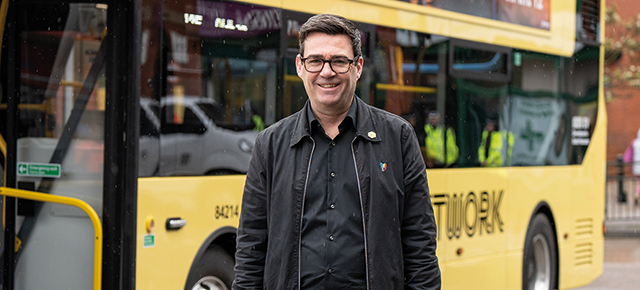 Andy Burnham: Bus journeys have increased by 14% year-on-year in the first franchising areas
BY Andy Burnham
When we launched the Bee Network, our vision was clear: to create a fully integrated, London-style public transport system that puts people first. Today, I’m proud to say that Greater Manchester is not just talking about transformation – we’re delivering it.
An early report exploring the impact of bus franchising in Greater Manchester offers evidence that our bold decision to bring buses back under public control is already paying off.
But more than that, it sets out a roadmap for how we intend to build a bus network that is affordable, reliable, and fit for the future.
And, as our new 10-year Greater Manchester Strategy makes clear, we are committed to delivering a public transport system befitting of a global city region.
Why franchising was necessary
For too long, bus services in Greater Manchester – and numerous other areas across the country – were in decline. Deregulation left us with a fragmented system; one that was shrinking, expensive, and often unreliable. By 2022/23, our bus network was nearly 40% smaller than it had been in the 1970s. A single journey could cost up to £4.50 and, on some routes, buses were late a third of the time.
This was not just a transport issue, it was also an issue of inclusion, accessibility and opportunity – all tying into our mission to deliver the economic growth Greater Manchester needs, if we are to fulfil our huge potential.
Buses are our city region’s most used form of public transport, and the people who rely on them most are often those with the fewest alternatives – those who don’t have the option of jumping in a car and driving when bus services let them down.
Following the pandemic, our network continued to shrink. Immediately before franchising, over 20% of services were reliant on support from Transport for Greater Manchester and that figure was rising.
Without taking our bus network under local control, we would continue to see the loss of important links, while the costs of preserving connectivity would continue to rise.
That’s why, in March 2021, I made the formal decision to proceed with bus franchising. The transition was completed in three phases between September 2023 and January 2025. It was a complex process, but it has given us the tools to reshape the network in the public interest, putting people before profit.
Let me be clear, I don’t sign up to the argument that bus franchising is a drain on the public purse.
No public transport system I know of exists without some form of subsidy. The decline of the bus market in previous decades meant that we had a choice between accepting reduced services or using increasing levels of public money to subsidise private operators, with little control over where and how this money was spent.
In Greater Manchester we are aiming for significant growth over the next 10 years. It’s therefore imperative we view the costs of bus franchising in the context of the benefits and opportunities it brings to residents, businesses and public services across our city region – not just in terms of revenue raised through fares.
Early results: A strong start
The early results are encouraging. Since the launch of Bee Network buses in September 2023, we’ve seen real improvements in service quality and customer experience. Newer, yellow buses – nearly one in five of them electric (a tenfold increase) – are now a common sight on our roads. Services are more frequent, more reliable, and more affordable.
Let me be clear, I don’t sign up to the argument that bus franchising is a drain on the public purse
In the areas that first came under bus franchising, we regularly exceed our target of 80% of services arriving on time, compared to a figure of around 66% pre-franchising. In March this year, on-time punctuality across the whole network was 75.8% compared to 71.6% in March 2024, when only around 20% of our network was franchised.
We’ve introduced a £2 cap on single journeys – which will remain in place until at least the end of this year – and cut the cost of travel for people by reducing the price of daily, weekly, or longer-term products. Along with daily and weekly fare caps and a ‘Tap and Go’ contactless payment system for people who want to use buses and trams, we ensure Bee Network passengers always pay the lowest possible fare.
And we’ve also improved real-time information and made it easier to plan and pay for journeys – rebuilding trust in a system that had let people down for too long.
We are not only reversing the long-term decline in bus use but also laying the foundations for a network that can grow and thrive.
The number of bus journeys has increased by 14% year-on-year in the first franchising areas and we’re initially aiming for a 30% increase in bus patronage by 2030 from 2022/23 levels. This would mean almost 50 million more journeys being taken by bus each year.
Sustainability is also key. We’re making rapid progress to electrify our bus fleet our depots and are on track to have a full electric network by 2030. Locking in a long-term, stable supply of renewable energy will help us meet that goal, delivering new net-zero infrastructure and driving down emissions across the network. Our investment in electric buses is also playing an important role in supporting UK bus manufacturers.
More than just buses
Bus franchising is only the beginning. The Bee Network is about integration – buses, trams, walking, cycling, and eventually local rail, all working together as one system. It’s about creating a network that is simple, accessible, and accountable – making it easier to get around and connecting every community like never before.
Talk to our teams, ride our buses, and hear from the people whose lives are already being changed
We’ve already made strides in driving up operational performance, integrating ticketing and branding. Our ambition is to go further, with a single app, a single fare structure, and a single set of standards across all modes of transport. We want people to be able to move seamlessly across Greater Manchester, confident that the system will work for them.
This is not just about convenience, it’s about opportunity. A truly integrated transport system can unlock access to jobs, education, and healthcare. It can also support economic growth, reduce congestion, and help us meet our climate goals.
Providing a world class public transport system for a global city region is a key pillar of the Greater Manchester Strategy (GMS), a plan to ensure people and communities across the region can feel the benefits of continued economic growth over the next 10 years.
The GMS pledges to continue developing the Bee Network into a transport system for a global city region, so that by 2030, 90% of the population live within 400 metres – a five-minute walk or wheeling distance – of a bus or tram that comes at least every 30 minutes.
We’ve become the UK’s fastest growing economy and sustained investment in the right transport infrastructure will underpin Greater Manchester’s growth, creating better local, regional, national and international connections for our global city region. Moreover everyone will be able to travel around our city region on safe, affordable, accessible and reliable public transport – opening up access to opportunities and helping people to live well and get on in life.
Challenges and lessons learned
Of course, this transformation hasn’t been without its challenges. Mobilising a franchised network is a massive logistical undertaking. It requires the transfer of depots, vehicles, and staff – often overnight. It demands new technology, new systems, and new ways of working.
We’ve learned a lot along the way. We’ve seen the importance of strong local leadership, clear communication, and close collaboration with operators and unions. We’ve also seen the need for long-term funding certainty, from both central government and local sources.
That’s why we’re calling for legislative changes to streamline the franchising process and make it easier for other areas to follow our lead. The Better Buses Bill, currently making its way through Parliament, is a step in the right direction and will hopefully support areas that decide bus franchising and emulating the Bee Network is the right option for them.
Safety is our priority
I want to leave no one in any doubt that safety is my absolute top priority when it comes to Bee Network bus services – and we’re doing more than ever to ensure people are safe on the network and, almost as importantly, feel safe when using it.
We are creating a safe and secure network, where customers can feel confident about travelling with us, without experiencing anti-social behaviour or feeling unsafe. We know many women and girls did not feel safe travelling on public transport before the Bee Network and we’re working hard to address this.
And our Vision Zero strategy aims to eliminate road deaths and life-changing injury by 2040, with a target to achieve a 50% reduction by 2030. We’re currently working with operators and trade unions to develop a Bee Network safety plan that reflects that reflects the ambitions of the strategy.
A blueprint for the nation
Greater Manchester is proud to be the first place in the UK to take back control of its buses and we are ready to share the lessons we’ve learnt with others. Our experience shows that public control works. It delivers better services, better value, and better outcomes for communities.
We’re already sharing our lessons with other city regions, including West Yorkshire and South Yorkshire, who are now on their own journeys toward local control. We believe the Bee Network can be a blueprint for other areas of the country, a model of how to build a transport system that works for people and places.
Looking ahead
There’s still much more to do, more routes to improve, more buses to electrify by 2030, more communities to connect. But we’re on the right path.
Our vision is bold, but it’s achievable. A world-class, integrated transport system for Greater Manchester – one that is affordable, reliable, and sustainable. One that supports our ambitions for a greener, fairer, and more prosperous city region.
To the delegates at the UK Bus Summit: I invite you to come and see what we’re building. Talk to our teams, ride our buses, and hear from the people whose lives are already being changed. Together, we can deliver better bus services … not just for Greater Manchester, but for the whole of the UK.
ABOUT THE AUTHOR: Andy Burnham, mayor of Greater Manchester, will speak at the UK Bus Summit in Manchester on September 11
This story appears inside the latest issue of Passenger Transport.
DON’T MISS OUT – GET YOUR COPY! – click here to subscribe!